Nootropics vs Coffee for Focus: Which Is Better for Everyday Concentration?
| The honest verdict | Neither wins outright — coffee is a fast, short-term lift; a daily nootropic is steady background support. They solve different problems. |
| Coffee is best for | An occasional early start or a one-off late deadline, in a sensible amount. |
| A nootropic is best for | Consistent day-to-day support you build into a routine, without a stimulant spike and crash. |
| Can you use both? | Most healthy adults do — just keep an eye on total caffeine and read every label. |
If your morning starts with a coffee and a hope that today will be the day you finally concentrate, you are in good company. Caffeine is the most widely used focus aid on the planet, and for good reason. But over the last few years a lot of people have started asking a sharper question: is reaching for another cup actually the best tool for the job, or would a daily nootropic supplement serve them better? This guide compares nootropics vs coffee for focus honestly, so you can decide what belongs in your own routine.
Rather than crown a winner, we will look at how each one works, where each genuinely shines, and where each falls short. Because the truth is that coffee and a daily nootropic are not really competitors — they are different tools that happen to get pointed at the same problem.
How coffee works for focus
Coffee’s active ingredient, caffeine, is a stimulant. In simple terms it blocks the brain receptors that make you feel sleepy, so alertness rises quickly. That is why a cup can feel like flipping a switch: within about thirty to sixty minutes you are more awake, reaction time sharpens, and a boring task feels a little less heavy.
Caffeine is the best-characterised cognitive substance in ordinary use. Reviewing the human literature, Nehlig concluded that caffeine reliably improves alertness, vigilance and reaction time, particularly when performance has already dipped, but is far less convincing as an enhancer of learning or memory (Nehlig, Journal of Alzheimer’s Disease, 2010).
The strengths of caffeine are real and worth respecting. It is fast, inexpensive, familiar, and effective for short-term alertness. If you are dragging before an early meeting or pushing through the last hour of a deadline, a coffee is a perfectly reasonable choice.
But the same speed that makes caffeine useful is also its catch. What goes up tends to come down.
The downsides most people know too well
- The crash. A big caffeine spike is often followed by a slump later in the day, particularly if you were already short on sleep. The lift was borrowed, not created.
- Tolerance. Drink it regularly and the same cup does less. Many people slowly climb from one coffee to three or four just to feel normal.
- Jitters and sleep debt. Too much, or too late in the day, can bring on a racing feeling and quietly wreck the night’s sleep — which is the very thing your memory and focus depend on most.
None of this makes coffee bad. It makes coffee a short-term tool that works best when used deliberately rather than as an all-day drip.
How a daily nootropic works for focus
A nootropic is any ingredient or supplement taken to support cognitive function — think memory, focus and everyday mental performance. The word covers a huge range, from single compounds to blended formulas, and it is worth knowing the difference between a single-ingredient nootropic and a blend before you buy.
A daily capsule is playing a slower game, and the evidence is correspondingly slower and softer. Systematic review of herbal and nutritional cognition products in older adults found modest, uneven effects that only appear across weeks of consistent dosing (Cave et al., Systematic Reviews, 2023). That is a genuinely different proposition from a cup of coffee, not a better version of one.
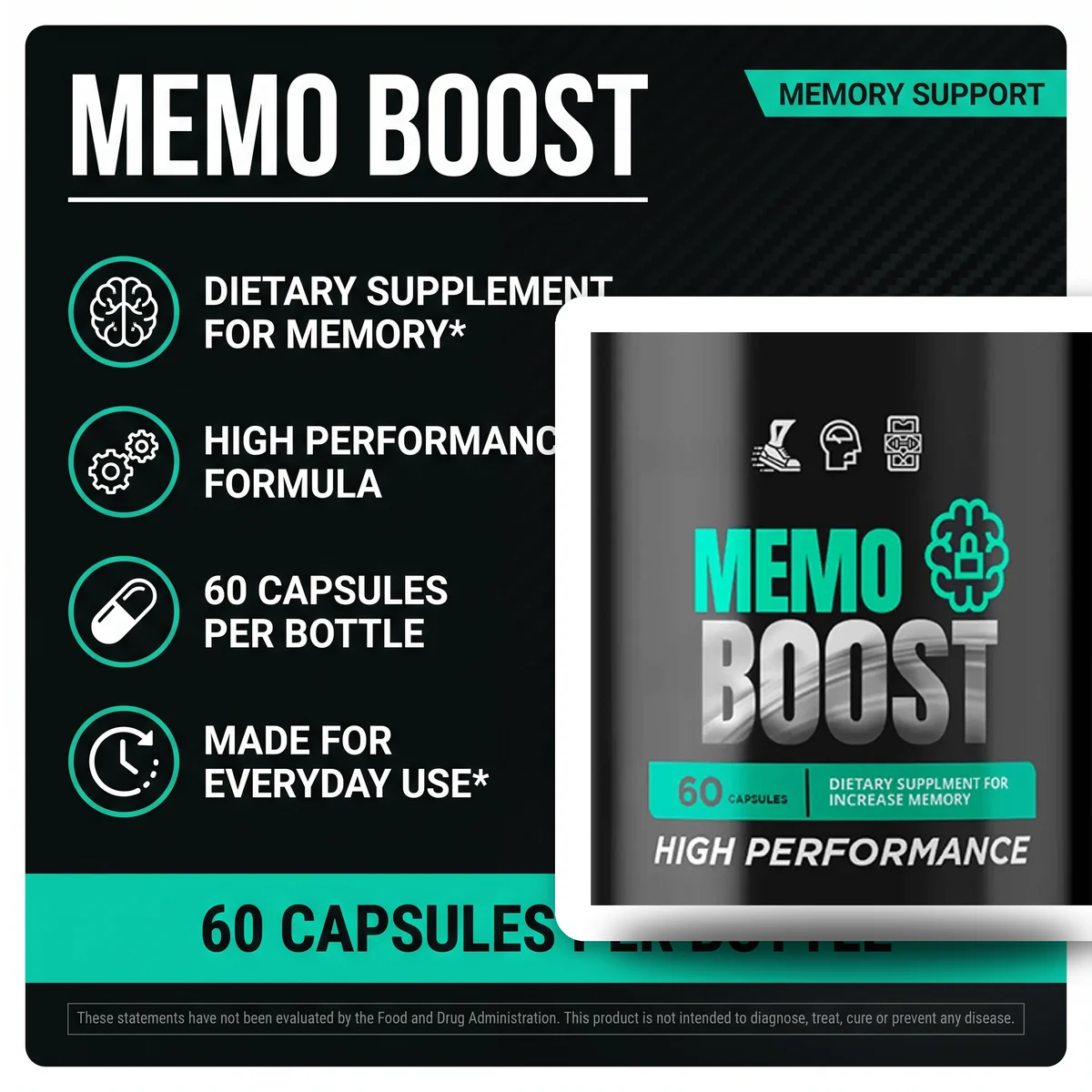
The key distinction from coffee is intent. A caffeine hit is designed for an acute, short-lived jolt. A daily nootropic like Memo Boost is designed as steady, everyday support you build into a routine — one simple capsule taken consistently, so it becomes a quiet background habit rather than a spike you feel and then lose.
Because a non-stimulant daily nootropic is not built around a stimulant hit, it does not create the same dramatic rise-and-fall curve. You are not chasing a peak, so there is no matching crash to pay for later. That trade-off — less instant drama, more consistency — is the whole point.
Want steady daily support instead of another cup?
Memo Boost is a simple daily nootropic capsule made for focused work, study and ordinary busy days — backed by a 60-day money-back guarantee.
See Memo Boost PackagesNootropics vs coffee for focus: side by side
Here is the honest comparison, factor by factor. As you read it, notice that most rows are not “better vs worse” so much as “fast vs steady.”
Speed of effect
Coffee wins on speed. Caffeine is felt within the hour. A daily nootropic is not an on-demand jolt; it is cumulative support that rewards consistency over days and weeks. If you need something for the next twenty minutes, that is coffee’s home turf.
Consistency through the day
A daily nootropic wins on steadiness. Coffee gives you a curve — up, plateau, down. A non-stimulant nootropic is designed to sit in the background without that spike, so your energy for focus is less of a rollercoaster.
The afternoon crash
Advantage nootropic. The classic slump usually traces back to an earlier caffeine spike layered on top of poor sleep. Because a non-stimulant daily capsule does not create that spike, it does not owe you a crash. That said, no supplement replaces sleep and steady meals — the fundamentals still run the show.
Tolerance over time
Advantage nootropic. Caffeine tolerance is well documented: the same dose does less as your body adapts. Non-stimulant nootropic ingredients are taken as ongoing daily support rather than for an acute effect, so the creeping “I need more to feel it” pattern is not the same story.
Sleep
Advantage nootropic, if it is stimulant-free. Late-day coffee is one of the most common hidden sleep-wreckers. A daily capsule taken in the morning does not sabotage your night the way a 4 p.m. espresso can.
Cost and convenience
Roughly even. A home coffee is cheap; daily cafe runs are not. A daily supplement is a predictable monthly cost. Convenience is a wash: one is a drink, the other is a single capsule with water.
So which should you choose?
The most useful reframe is to stop treating this as a duel. Ask instead: what is the job in front of me?
If the answer is the capsule, the practical follow-up is what shape it should take — our comparison of nootropic capsules versus powder explains why a pre-measured capsule is the format most likely to survive a busy morning.
- One-off alertness — an early flight, a single late deadline, a groggy Monday. A sensible coffee is a fine tool.
- Consistent everyday support — study season, a demanding project, the ordinary grind of a busy working week. This is where a simple daily nootropic earns its place, because the benefit is in the routine, not the spike.
- Both, used thoughtfully — many healthy adults keep a morning coffee they enjoy and add a daily nootropic for steady background support. The key is to watch your total caffeine, especially since some pre-workout style blends stack stimulants on top.
Whatever you choose, the boring fundamentals still decide most of the outcome. If you want the full picture beyond supplements and coffee, our guide to improving memory and focus naturally covers the sleep, movement and attention habits that move the needle most. And if you have decided a supplement belongs in your routine, read how to choose a memory supplement before you spend a penny.
A quick word on doing this safely
Coffee and nootropics are both easy to overdo. With caffeine, the risk is stacking cups until sleep and nerves suffer. With supplements, the risk is ignoring the label. Read the directions, keep expectations realistic, and if you are pregnant or nursing, under 18, taking medication or managing a health condition, talk to your doctor first. For a fuller look at supplement safety, see are nootropic supplements safe.
Whichever way you lean, the ceiling is the same: the FDA points to 400 mg of caffeine a day as the level not generally associated with negative effects in healthy adults (U.S. Food and Drug Administration), and caffeine taken as much as six hours before bed still measurably cuts sleep (Drake et al., 2013).
Make focus a one-capsule habit
Instead of a fourth coffee, keep it simple: Memo Boost is a single daily nootropic capsule made for work, study and everyday focus — try it with a 60-day money-back guarantee.
 Order Memo Boost Today
Frequently asked questions
Are nootropics better than coffee for focus?
Neither is simply better; they do different jobs. Coffee gives fast, short-lived alertness driven by caffeine, while a daily nootropic supplement is designed as steady background support you build into a routine. Many people use a sensible amount of coffee for the morning lift and a nootropic for consistent everyday support.
Can I take a nootropic and drink coffee on the same day?
For most healthy adults, moderate coffee alongside a daily nootropic is common. The main thing to watch is total caffeine, because some pre-workout style nootropic blends already contain stimulants. Read the label, keep an eye on how much caffeine you are getting in total, and check with your doctor if you take medication or have a health condition.
Does coffee cause a crash and do nootropics avoid it?
The classic afternoon slump often follows a big caffeine spike earlier in the day, especially on little sleep. A non-stimulant daily nootropic does not create that same rise-and-fall curve because it is not built around a stimulant hit, though nothing replaces good sleep and steady meals.
Will I build a tolerance to nootropics like I do to caffeine?
Caffeine tolerance is well known, which is why the same cup does less over time. Non-stimulant nootropic ingredients work differently and are generally taken as steady daily support rather than for an acute jolt, so the tolerance pattern is not the same. Follow the label and give any supplement a fair, consistent trial.
Which should a student or professional choose?
It depends on the goal. For an occasional early start or a late deadline, a coffee is a reasonable tool. For consistent day-to-day support during study season or a demanding work stretch, a simple daily nootropic capsule fits the routine better. The two are not mutually exclusive.
References
- Nehlig A (2010). Is caffeine a cognitive enhancer? Journal of Alzheimer’s Disease, 20(S1). PMID 20182035
- Cave AE, Chang DH, Munch GW, Steiner-Lim GZ (2023). A systematic review of the safety and efficacy on cognitive function of herbal and nutritional medicines in older adults with and without subjective cognitive impairment. Systematic Reviews, 12. PMID 37592293
- Drake C, Roehrs T, Shambroom J, Roth T (2013). Caffeine effects on sleep taken 0, 3, or 6 hours before going to bed. Journal of Clinical Sleep Medicine, 9(11). PMID 24235903
- U.S. Food and Drug Administration. Spilling the Beans: How Much Caffeine Is Too Much? fda.gov
- National Center for Complementary and Integrative Health. Dietary and Herbal Supplements. nccih.nih.gov
- National Heart, Lung, and Blood Institute. Sleep Deprivation and Deficiency. nhlbi.nih.gov
† These statements have not been evaluated by the FDA. This product is not intended to diagnose, treat, cure or prevent any disease. This article is for general information only and is not medical advice.