How to Improve Memory and Focus Naturally: A Practical Daily Guide
| The idea | Memory and focus are trainable — they respond to daily habits far more than to any single trick. |
| Biggest levers | Sleep, movement, blood-sugar-friendly nutrition and protecting your attention. |
| The mindset | Small, consistent routines beat occasional heroic effort every time. |
Most of us don’t want a genius-level memory. We want the ordinary kind that works: remembering the name of the person we just met, holding three steps of a task in our head, walking into a room and knowing why. The good news is that everyday memory and focus are far more trainable than people assume. They respond to a handful of daily habits — and to how you treat your attention — much more reliably than to any one clever hack.
This guide walks through the levers that actually move the needle, roughly in order of impact. None of them require a lab, a coach or a fortune. They just require you to do the simple things consistently.
1. Protect your sleep first
If you only change one thing, change your sleep. During deep and REM sleep, the brain consolidates the day’s learning — effectively moving fragile short-term memories into more durable long-term storage. Skimp on sleep and you don’t just feel foggy; you literally file away less of what you learned.
This is not folk wisdom. Sleep is when fragile new memories are stabilised and integrated with what you already know, and the consolidation research treats that process as one of sleep’s core functions rather than a side effect (Yasser et al., Progress in Brain Research, 2026). Sleep deprivation degrades attention and learning before you feel especially tired (NHLBI).
Aim for a consistent seven to nine hours, with an emphasis on consistent. A regular wake time anchors your body clock better than any single early night. Keep the last hour before bed dim and screen-light, and treat caffeine after early afternoon as a sleep thief in disguise — it can linger in your system for hours.
2. Move your body most days
Physical activity is one of the most reliable, best-studied ways to support brain health. Aerobic movement increases blood flow to the brain and supports the growth factors involved in learning and memory. You don’t need to train like an athlete: a brisk daily walk, a bike ride, or a couple of strength sessions a week all count.
Exercise has the strongest causal evidence of anything on this page. In a randomised controlled trial, a year of moderate aerobic walking increased hippocampal volume and improved spatial memory relative to a stretching control, effectively reversing one to two years of age-related shrinkage (Erickson et al., PNAS, 2011).
A useful trick is to move before mentally demanding work. A ten-minute walk before you sit down to study or tackle a hard problem can leave you noticeably more alert and better able to concentrate.
3. Feed your brain steady fuel
Your brain runs on a steady supply of glucose and depends on a range of nutrients to work well. The pattern that tends to help most is unglamorous: whole foods, plenty of vegetables, healthy fats, enough protein, and fewer sharp spikes and crashes in blood sugar.
Of the individual nutrients, long-chain omega-3 fats have the most plausible mechanism, though the trial results in healthy adults remain mixed and dose-dependent (Welty, Current Opinion in Lipidology, 2023). The NIH Office of Dietary Supplements reaches the same cautious conclusion in its omega-3 fact sheet (NIH ODS).
- Favour slow carbs — whole grains, legumes and fruit over refined sugar, so energy to the brain stays even.
- Include healthy fats — oily fish, nuts, seeds and olive oil support the fatty tissue your brain is largely built from.
- Stay hydrated — even mild dehydration measurably dents concentration and short-term memory.
You don’t need a perfect diet. You need a mostly-good one you can keep to, most days.
Want memory support built into your day?
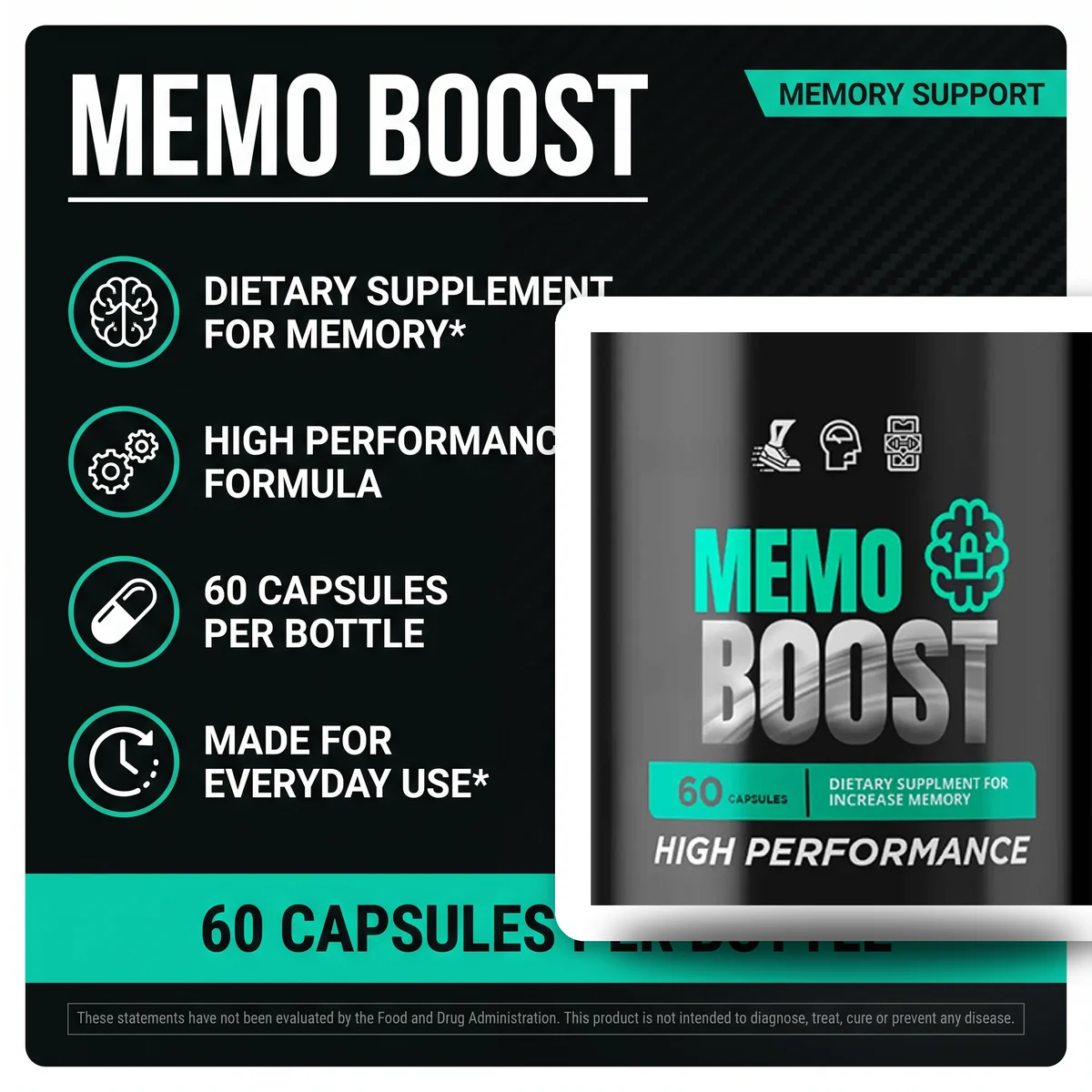
Memo Boost is a simple daily nootropic capsule made for focused work, study and ordinary busy days — backed by a 60-day money-back guarantee.
See Memo Boost Packages4. Train your attention, not just your memory
Here’s a truth that surprises people: a lot of “bad memory” is really divided attention. You can’t remember where you put your keys because you were never fully present when you put them down. The fix is less about memory and more about focus.
The single most effective habit is to single-task on purpose. When something matters, give it one uninterrupted block of attention. Silence notifications, close the extra tabs, and let your brain actually encode what’s happening. Techniques like short focused sprints followed by a real break help your attention recover instead of grinding down through the day.
5. Use simple memory techniques
A few classic techniques punch well above their weight because they work with how memory forms:
- Spaced repetition — review information a day later, then a few days later, then a week later. Each well-timed review strengthens the trace.
- Say it, link it — repeat a new name aloud and tie it to something you already know. Meaningful connections stick; isolated facts slide off.
- Offload the trivial — write down what doesn’t need to live in your head, so your working memory is free for what does.
6. Manage stress and give your brain breaks
Chronic stress floods the body with cortisol, which over time is hard on the very brain regions involved in memory. You can’t eliminate stress, but you can build in recovery: a few minutes of slow breathing, time outdoors, a hobby that absorbs you, or simple mindfulness practice. Even short breaks in nature have been linked with better attention afterwards.
7. Keep learning and stay socially engaged
Memory is a use-it-or-lose-it system. Novelty and challenge are what keep it limber, so the goal is to give your brain regular reasons to work a little harder than it’s used to. That doesn’t mean brain-training apps that only make you better at the app — it means genuinely new learning that stretches you.
Pick up an instrument, learn a language, take up a craft, or simply read outside your usual lane. Just as valuable is staying socially connected: real conversation is a surprisingly demanding cognitive workout, and strong social ties are consistently linked with healthier ageing brains. A weekly call with a friend can do more for long-term memory than another productivity hack.
8. Where a supplement fits in
Once the fundamentals are in place, some people like to add a daily memory-support supplement as everyday backup. Think of it as sitting on top of good habits, not replacing them. A supplement like Memo Boost is built around exactly that idea: one simple capsule a day, designed to be easy to keep up so it becomes a quiet part of your routine.
If you decide to add one, three companion guides do the buying work: the ingredients that appear most often in memory formulas explains what you are reading on a panel, nootropics versus multivitamins settles which type you actually need first, and how to tell if a nootropic is working shows how to judge the result without fooling yourself.
Whatever you choose, be a careful consumer. Read the label, follow the directions printed on it, keep your expectations realistic, and check with your doctor first if you’re pregnant or nursing, under 18, taking medication or managing a health condition.
Putting it together
You don’t need all eight of these perfectly. Start with sleep, add a daily walk, protect one focused block a day, and let the rest follow. Memory and focus aren’t fixed traits — they’re the running total of what you do most days. Build a routine you can actually keep, and let consistency do the heavy lifting.
Frequently asked questions
Can you really improve memory naturally?
You can’t rewire your brain overnight, but the habits that support memory — good sleep, regular movement, a nutrient-rich diet and protecting your attention — are well established and cumulative. Most people notice the biggest difference from fixing sleep and reducing constant distraction.
How long does it take to see a difference?
Attention habits like single-tasking can help the same day, while sleep, exercise and nutrition build up over weeks. Consistency matters far more than intensity — a small routine you keep beats a big one you abandon.
Do memory supplements work?
A dietary supplement is best thought of as everyday support that sits on top of the fundamentals, not a replacement for them. Always read the label, follow the directions, and talk to your doctor if you take medication or have a health condition.
Make it a one-capsule habit
If you want memory support you’ll actually stick with, Memo Boost keeps it to a single daily capsule — made for work, study and everyday focus.
Order Memo Boost TodayReferences
- Yasser E, et al. (2026). Sleep and memory consolidation: neural and cognitive perspectives. Progress in Brain Research. PMID 42547206
- Erickson KI, Voss MW, Prakash RS, et al. (2011). Exercise training increases size of hippocampus and improves memory. Proceedings of the National Academy of Sciences, 108(7). PMID 21282661
- Welty FK (2023). Omega-3 fatty acids and cognitive function. Current Opinion in Lipidology, 34(1). PMID 36637075
- National Institutes of Health, Office of Dietary Supplements. Omega-3 Fatty Acids — Health Professional Fact Sheet. ods.od.nih.gov
- National Institutes of Health, Office of Dietary Supplements. Dietary Supplements for Cognitive Function, Dementia, and Alzheimer’s Disease. ods.od.nih.gov
- National Heart, Lung, and Blood Institute. Sleep Deprivation and Deficiency. nhlbi.nih.gov
† These statements have not been evaluated by the FDA. This product is not intended to diagnose, treat, cure or prevent any disease. This article is for general information only and is not medical advice.