How to Tell If a Nootropic Is Working: Signs to Track & How to Test
| Look for subtle signs | Fewer lost trains of thought, easier task starts, less late-day mental fatigue — not a dramatic switch. |
| Set a baseline first | Write down how focus and memory feel before you start, so you have something to compare against. |
| Give it a fair window | Judge over several weeks of consistent daily use, not a single afternoon. |
| Be honest about placebo | Track concrete markers, not a vague sense of sharpness — and use the guarantee if it is not for you. |
You have been taking your capsule for a couple of weeks, and now the nagging question arrives: how do I tell if a nootropic is working? Unlike a painkiller or a strong coffee, an everyday memory supplement rarely announces itself. There is no obvious “on” switch, which leaves a lot of people quietly wondering whether they are feeling a genuine effect, imagining one, or wasting their money. This guide gives you a practical, honest way to answer that — the signs to watch, how to run a fair self-test, and when to call it.
The first thing to accept is that the effect you are looking for is usually subtle and cumulative, not dramatic. Setting that expectation correctly is half the battle, because people who expect a jolt often conclude “nothing happened” when in fact they were looking for the wrong thing entirely.
The realistic signs a nootropic is working
An everyday nootropic is designed as steady background support, so the signs it is working tend to be quiet and easy to miss unless you are paying attention. Look for changes like these:
- Fewer dropped trains of thought. You lose your place mid-task or mid-sentence a little less often.
- Easier task starts. Settling into focused work feels marginally less effortful — less friction getting going.
- More stamina late in the day. The familiar afternoon mental fog feels a touch lighter.
- Smoother recall. Names, numbers and where-you-left-things come to mind a little more readily.
- Steadier focus, not a spike. A sense of even concentration rather than a sharp high followed by a crash.
Notice that none of these is dramatic. A daily supplement is quiet support, not a stimulant hit. If you are expecting fireworks, read our guide on how long nootropics take to work to reset your expectations before you judge anything.
Step 1: Set a baseline before you start
This is the single most useful thing you can do, and almost nobody does it. Because the effect is gradual, your memory of “how things were before” is unreliable — it quietly drifts. The fix is to capture a baseline in writing at the very start, ideally before your first capsule. Spend five minutes noting, on a simple 1–10 scale:
You cannot detect a change you never measured. The NIH Office of Dietary Supplements notes that cognitive outcomes are difficult to assess even in formal research because the measures are noisy and expectations are hard to control (NIH Office of Dietary Supplements). A written baseline is the amateur version of the control every trial builds in.
- How easily you focus on a typical work or study block.
- How foggy or sharp you feel by mid-afternoon.
- How often you misplace things or forget small tasks.
- Your general mental energy across the day.
Now you have something concrete to compare against, instead of a fuzzy feeling. If you have already started, do it today anyway — a baseline a week in is still far better than none.

Step 2: Run a fair, consistent trial
A fair test needs three things: consistency, time and stable conditions. Take the supplement every single day, exactly as directed, for a few weeks — an on-and-off pattern proves nothing. Give it long enough for cumulative support to build. And try not to change five other things at once; if you overhaul your sleep, start a new diet and take a supplement in the same week, you will never know what did what. Keep the free fundamentals steady and in place, since those do the heavy lifting anyway. If sleep and movement are a mess, fix those first with our guide on improving memory and focus naturally, then judge the supplement on top of a solid base.
Copy the shape of a real study. The bacopa trial people cite ran double-blind and placebo-controlled for twelve weeks, with dosing held constant throughout (Calabrese et al., 2008). You cannot blind yourself, but you can hold the dose, the timing and the length steady, which is most of the value.
A fair trial, made low-risk
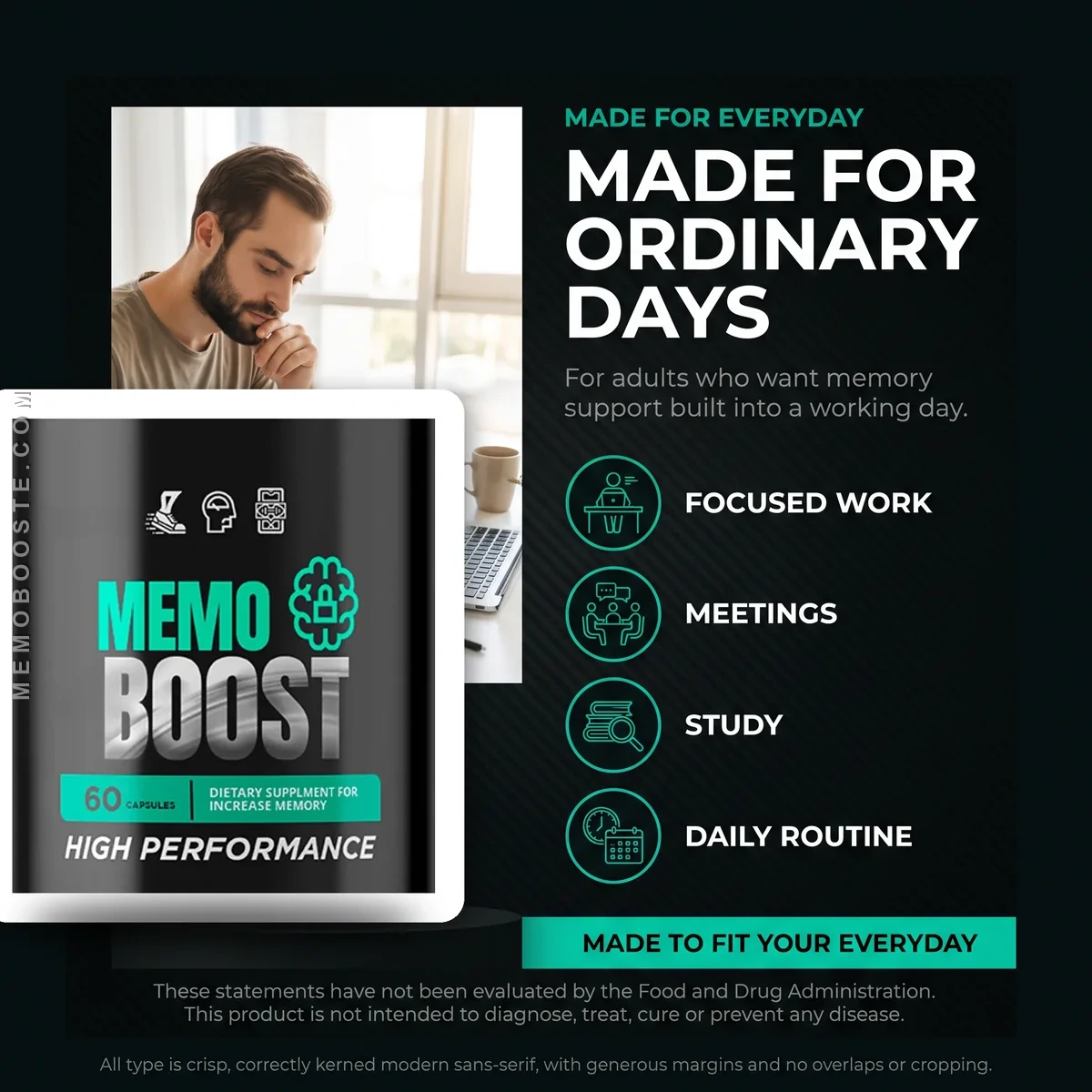
Memo Boost is a single daily nootropic capsule made in the USA in a GMP-registered facility — backed by a 60-day money-back guarantee, so you can run a proper multi-week trial and decide for yourself.
See Memo Boost PackagesStep 3: Track concrete markers, not vibes
“I feel sharper” is easy to imagine and hard to trust. Concrete markers are far more honest. Instead of rating a vague sense of sharpness, track things you can actually count or observe:
- Tasks completed in a focused block, or how far you get before your attention drifts.
- How long you can work before needing a proper break.
- Specific memory wins or misses — did you remember the appointment, the name, the errand?
- Afternoon energy, rated on the same 1–10 scale as your baseline.
Jot a one-line note at the end of each day. It takes seconds, and after a few weeks the pattern — or the absence of one — is usually clear. Comparing that log against your baseline is how you turn a hunch into an actual answer.
Step 4: Be honest about the placebo trap
Any honest guide has to name it: expectation alone can create a real feeling of benefit. That does not make you gullible; it is simply how human perception works. The point is not to be cynical but to be rigorous. Written logs, concrete markers and a proper baseline all help you separate a genuine change from wishful thinking. If your notes show more tasks finished and steadier afternoons compared with your baseline, that is real signal. If the only evidence is a warm feeling that the pill must be doing something, treat it with healthy caution.
Placebo control exists in this field precisely because expectation moves cognitive scores. Reviews of herbal and nutritional cognition trials repeatedly find that effects shrink or disappear once a placebo arm is included, which is why uncontrolled personal impressions run so far ahead of the data (Cave et al., Systematic Reviews, 2023).
Step 5: Know when it is — and is not — working
After a fair, consistent, multi-week trial with good habits in place and honest tracking, you will usually land in one of three places:
- Clear benefit. Your markers have genuinely improved over baseline. Keep going, and consider a package to lower the cost per day of a routine you now trust.
- Marginal or uncertain. Small, hard-to-pin-down changes. It may be worth continuing a little longer, or weighing the cost against the modest benefit — see our honest look at whether memory supplements are worth it.
- Nothing meaningful. After a genuinely fair trial, no worthwhile change. That is a perfectly valid result — it simply may not be for you, and a money-back guarantee is exactly what makes finding that out low-risk.
And two non-negotiables: stop and speak to a healthcare professional if you have any adverse reaction, and always follow your product's label and your doctor's guidance over any general article.
Test it for yourself, risk-free
Memo Boost keeps it simple: one clearly-labelled daily capsule, made in the USA, with a 60-day money-back guarantee. Multi-bottle packages lower the per-bottle cost of a routine you decide to keep.
 Order Memo Boost Today
Frequently asked questions
How do I know if a nootropic is working?
Look for subtle, realistic signs rather than a dramatic switch: fewer moments of losing your train of thought, an easier time settling into a task, less mental fatigue late in the day, or recalling names and details a little more readily. Because these changes are gradual, the reliable way to notice them is to write down a simple baseline before you start and compare it after a few weeks of consistent daily use.
How long before I can judge whether it is working?
Give an everyday nootropic a fair trial of several weeks of consistent daily use before drawing conclusions. Some effects may be noticeable sooner, but the cumulative support these products are designed for builds over time. Judging it after a single day or an occasional dose is not a fair test.
What if I do not feel anything?
Not feeling a dramatic jolt is normal and expected — everyday nootropics are designed as quiet, steady support, not a stimulant hit. Check that you are taking it consistently and as directed, that the free fundamentals like sleep and movement are in place, and that your expectations are realistic. If, after a fair multi-week trial with all of that handled, you genuinely notice nothing, it may simply not be for you, which is where a money-back guarantee helps.
Could it just be the placebo effect?
Possibly, and that is worth being honest about. Expecting a benefit can produce a real feeling of one. Keeping a simple written log, focusing on concrete markers like tasks completed rather than a vague sense of sharpness, and comparing against your pre-supplement baseline all help you separate a genuine change from wishful thinking.
When should I stop taking a nootropic?
Consider stopping if, after a fair and consistent multi-week trial with good habits in place, you notice no worthwhile benefit, if the cost per day does not feel justified, or if you experience side effects that concern you. Stop and speak to a healthcare professional if you have any adverse reaction, and always follow your product's label and your doctor's guidance.
References
- Calabrese C, Gregory WL, Leo M, et al. (2008). Effects of a standardized Bacopa monnieri extract on cognitive performance, anxiety, and depression in the elderly: a randomized, double-blind, placebo-controlled trial. Journal of Alternative and Complementary Medicine, 14(6). PMID 18611150
- Cave AE, Chang DH, Munch GW, Steiner-Lim GZ (2023). A systematic review of the safety and efficacy on cognitive function of herbal and nutritional medicines in older adults with and without subjective cognitive impairment. Systematic Reviews, 12. PMID 37592293
- National Institutes of Health, Office of Dietary Supplements. Dietary Supplements for Cognitive Function, Dementia, and Alzheimer’s Disease. ods.od.nih.gov
- National Center for Complementary and Integrative Health. Using Dietary Supplements Wisely. nccih.nih.gov
- National Institutes of Health, Office of Dietary Supplements. Dietary Supplements: What You Need to Know. ods.od.nih.gov
- U.S. Federal Trade Commission. Health Products Compliance Guidance. ftc.gov
† These statements have not been evaluated by the FDA. This product is not intended to diagnose, treat, cure or prevent any disease. This article is for general information only and is not medical advice.